Smart-Thread Innovative Fastening System

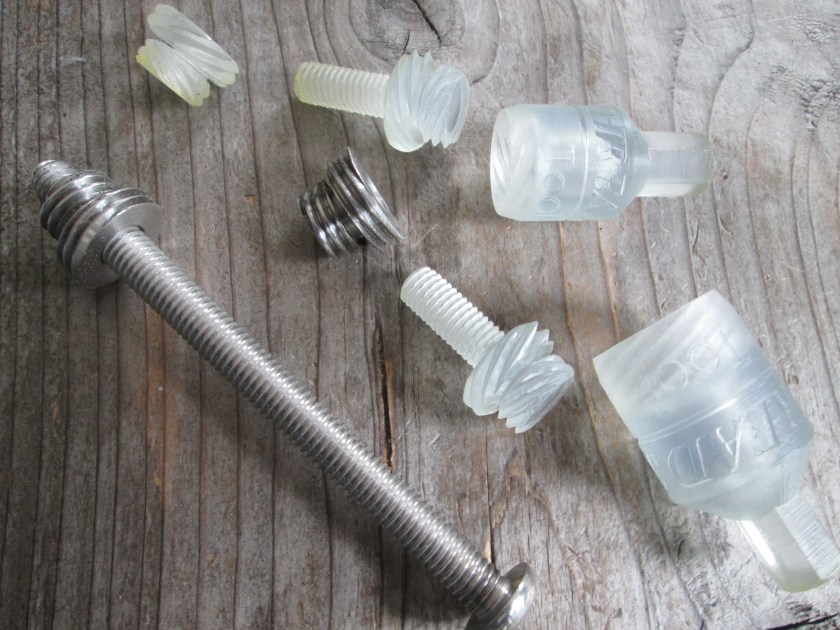
So this is the Smart-Thread innovative fastening system. It’s unusual. But bear with me as I try to explain why and what it could be used for.
In each of these pictures, there are two stainless steel nuts in which the smaller diameter has a two-start left-hand thread and the larger diameter has a two-start right-hand thread. Inside this is an 8mm internal thread that locks items in place. One nut is in the middle of the picture the other is on the long fastener. Any inside thread can be used.
But what I really wanted was a seven-start thread which I was unable to get made in the UK or anywhere else at the moment, the alternative is the plastic nut and fastener along with a locking tool and an un-locking tool which have been 3d Printed.
You still don’t get why or how it works. The pictures below show one fastener (or more commonly known as a bolt) located in a locking tool, this is the larger plastic item.
One fastener is located in an unlocking tool the smaller item.

So lets cut to the chase.
The locking tool spins in a clockwise direction and locks around the larger head of the nut or fastener in only about one-eighth of a turn and it is held in place and cannot fall off whatever position it is held in. The tool is used to lock the nut or fastener in position then the tool is spun in an anticlockwise direction and leaves the nut or fastener in place.
The unlocking tool is used to remove the nut or fastener, it is located on the smaller diameter and spins anticlockwise removing the nut or fastener which are retained in place and cannot fall off but can easily be removed by hand.
But what can it be used for and why is it different?
It has a broad base which means it securely locks items down.
Using threads to tighten it means a high level of torque is possible with very little wear.
It loads quickly on the locking tool and will not fall off so it is possible to fit in awkward positions and deep settings.
It can be fitted manually or using robotics, to; Automobiles, planes, trains, bikes, scooters, or anything.
If removal is not required it can be used in electronic circuits where only a small right-hand thread is required which again means it will not fall off and can be fitted, robotically, and in awkward positions.

What has happened to this country? I remember when I could go to Aston, Birmingham where Billy Snotts the old lathe turner with a permanent cold worked on a lathe driven by leather belts which required different cogs to be hand-fitted and he could produce all sorts of threads, especially after visiting the Dog and Patridge pub in Livery Street.
And you only needed to give him a drawing on the back of a woodbine packet.
OH, you tried to give him the woodbine packet before he went to the pub.
Now everything has to be on a disk or file and loaded into a machining center that cost £100000.00 and they still can’t turn a seven-start thread.
Billy is one hundred and six now but I may have to ask if he will do one last job; which may be difficult as he died when he was sixty-four. Still, it might be worth trying cause if you don’t ask you don’t get…
As a postscript after Billy died they buried his lathe with him, I recon Billy turned in his grave.
Thanks to Colin Cleobury for his help
All technical and design rights held by David, Tooth DJT Precision, Patents Pending
Enquires as Website

 Smart-thread.com.uk